Expert setup guide
Why string tension matters
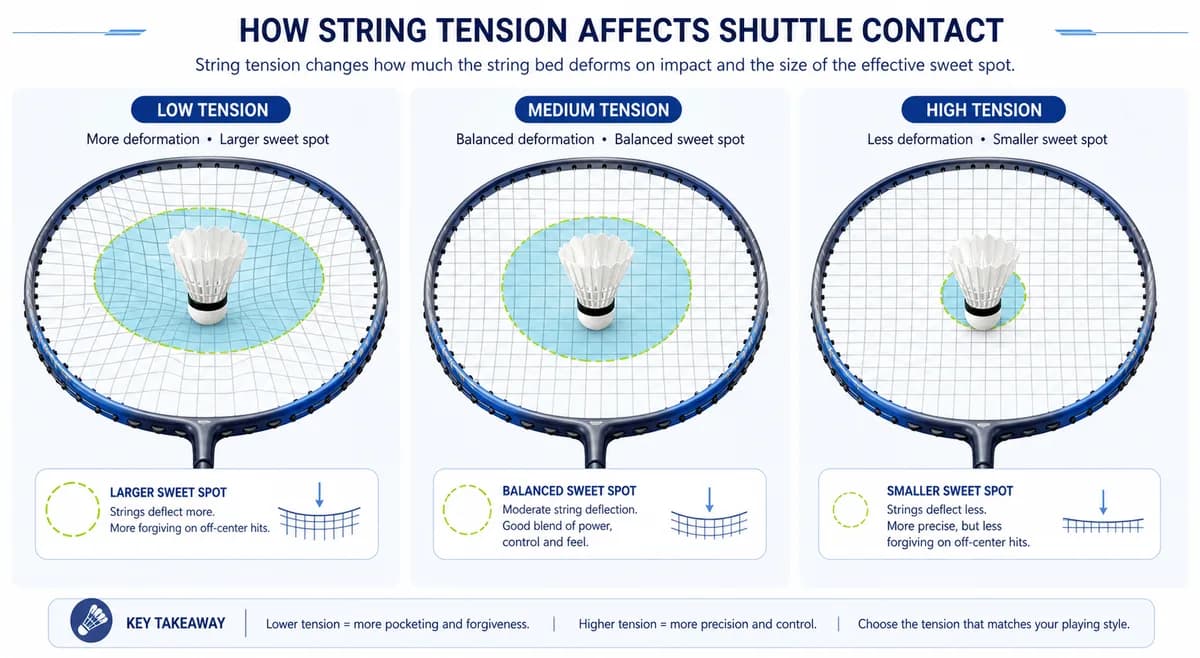
String tension matters because it directly changes a badminton racket’s power, control, sweet spot and forgiveness.
It is the force used to pull each string during stringing. Two identical frames can feel completely different at 20 lbs and 28 lbs.
Lower tension
- ✓ Larger, more forgiving sweet spot
- ✓ Easier rear-court length
- ✓ Kinder response on off-center contact
- Tradeoff: softer, less direct feedback
Higher tension
- ✓ Crisper, more immediate feedback
- ✓ Precise response for clean contact
- Tradeoff: smaller sweet spot
- Tradeoff: greater string and frame stress
Power, control and the real sweet spot
Power comes chiefly from rotation, relaxed acceleration and centered contact. Tension supports that system; it cannot replace technique.
- Developing swing: use the lower edge so the strings supply more rebound.
- Fast, repeatable swing: test the upper edge for shorter, more direct response.
- Power priority: favor forgiveness and easy length.
- Control priority: increase only while centered contact remains reliable.
How to choose the right tension
The right badminton string tension is the highest range you can use while still hitting the sweet spot consistently and comfortably.
- 1. Set the skill baseline.
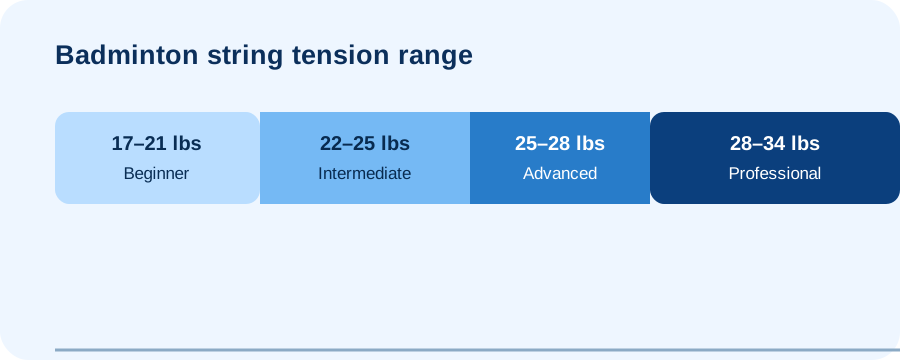
Use 17–21 lbs for beginners, 22–25 lbs for intermediate players, 25–28 lbs for advanced players, and 28+ lbs only with exceptional contact.
- 2. Adjust for your repeated shots.
Subtract about 1 lb for easier rear-court power, add 1 lb for firmer net response, or keep the baseline for all-round play.
- 3. Account for string gauge.
Thick 0.70 mm string favors durability; thin 0.65 mm string favors repulsion but demands cleaner contact and more frequent replacement.
- 4. Check the whole racket.
A stiff shaft and tight bed can become demanding. Frame condition and the printed tension limit override small theoretical adjustments.
Equipment decisions work together: use the Racket Balance Calculator to understand head weight and the Grip Size Calculator to check handling comfort. For material choices, review the string gauge guidance in this section and evaluate nearby tensions in the interactive comparison. These factors refine a setup, but none replaces centered contact.
Make one change at a time
- 1. Record racket, string, tension, date and stringer.
- 2. Play two or three normal sessions after settling.
- 3. Drop 1 lb if clears fall short and mishits feel dead.
- 4. Add 1 lb if net shots rebound unpredictably.
String tension myth vs fact
Higher tension does not automatically create more badminton power.
Reality: a rigid bed supplies less free rebound on slow or off-center swings.
Reality: it is a setup choice, not a ranking badge.
Reality: exact feedback helps only when contact and racket angle are already controlled.
Reality: damage, worn grommets and uneven stringing reduce the safe margin.
Top 6 string tension mistakes
The most common string tension mistake is choosing a number for status instead of consistency. Avoiding the following six errors produces a safer and more repeatable setup:
- 1. Copying professional tensions
Elite numbers require elite timing and frequent restringing.
- 2. Ignoring string gauge
Thin and thick strings behave and wear differently at the same tension.
- 3. Ignoring racket stiffness
A stiff shaft and tight string bed can make the full setup too demanding.
- 4. Restringing too late
Strings lose useful response long before they necessarily snap.
- 5. Choosing control over consistency
Precision means little when the sweet spot is too small to find reliably.
- 6. Increasing tension too quickly
Move one pound at a time and assess the setup across several sessions.
When to restring
You should restring approximately as many times per year as you play badminton each week.
- Plan: two weekly sessions suggest about two restrings per year.
- Inspect: dull sound, moving strings and uneven response signal tension loss.
- Replace now: deep notches, fuzzy filaments or exposed core need prompt action.
- Compare fairly: use the same settling period, machine type and trusted stringer.
Restring frequency guide
Restring when performance changes, using playing frequency as the planning baseline.
| Player profile | Playing frequency | Planned restring | Replace sooner when |
|---|---|---|---|
| Casual | 1–3 times monthly | Every 6–12 months | Feel becomes dull or strings fray |
| Weekly | Once weekly | Every 4–6 months | Control drops noticeably |
| Club player | 2–4 times weekly | Every 2–4 months | Tension loss affects consistency |
| Tournament player | 4–6 times weekly | Every 3–6 weeks | Before important competition |
| Professional | Daily training | Per event or as needed | Response changes between sessions |
String-bed symptom checker
Shot symptoms can identify whether tension, string age or technique should be checked first.
| Problem | Possible cause | Recommended check | Practical adjustment |
|---|---|---|---|
| Clears lack length | Tension too high | Compare centered and off-center shots | Reduce 1–2 lbs |
| Net shots rebound too far | Bed too soft | Check whether strings move excessively | Increase 1 lb |
| Harsh vibration | Small sweet spot or mishit | Inspect contact point and grommets | Reduce tension; check frame |
| Sudden dull response | Tension loss or damaged string | Look for notching and slipping knots | Restring |
| Frequent center breaks | Thin gauge or wear | Track hours and break location | Use thicker string |
| Breaks near frame | Mishit or damaged grommet | Inspect shared holes and sharp turns | Replace grommet before restringing |
String tension decision guide
Choose the first condition that best describes your current game, then make only that adjustment.
- 1. Set your skill range
- 2. Choose power or control
- 3. Test one 1 lb change
- If you are a beginner: start at 19–21 lbs.
- If you mainly play doubles: favor forgiveness unless your drive contact is consistent.
- If you have wrist discomfort: stop increasing tension and seek qualified advice if it persists.
- If you prefer control: test 1 lb above your comfortable baseline.
- If you generate your own power: use the upper end of your skill range.
- If you mishit under pressure: reduce tension by 1–2 lbs.
Last updated
Editorial review
Reviewed by Badminton Calculator Editorial Team
Reviewed for calculation consistency, source accuracy and clear separation between general guidance and manufacturer limits.
Sources and reference library
Manufacturer specifications and official rules take priority over general equipment ranges.
- BWF Statutes and LawsOfficial laws and equipment framework for badminton.
- Yonex Badminton Stringing InstructionsManufacturer stringing patterns and tie-off instructions.
- VICTOR Racket Selection GuidePublic manufacturer guidance on ability, tension and racket selection.
- Li-Ning Official Equipment SiteManufacturer product specifications; check the exact racket before stringing.