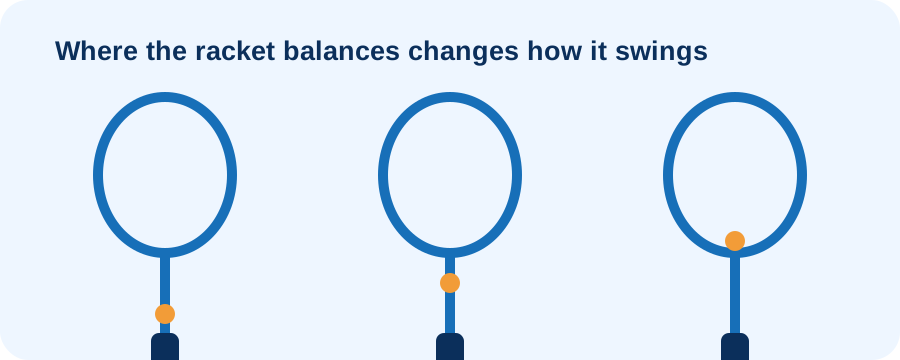
What is racket balance?
Racket balance describes where a badminton racket’s weight is concentrated along its length.
- Higher readingMore mass sits toward the head.
- Lower readingMore mass stays near the hand.
- Comparable readingMeasure with strings and your normal grip fitted.
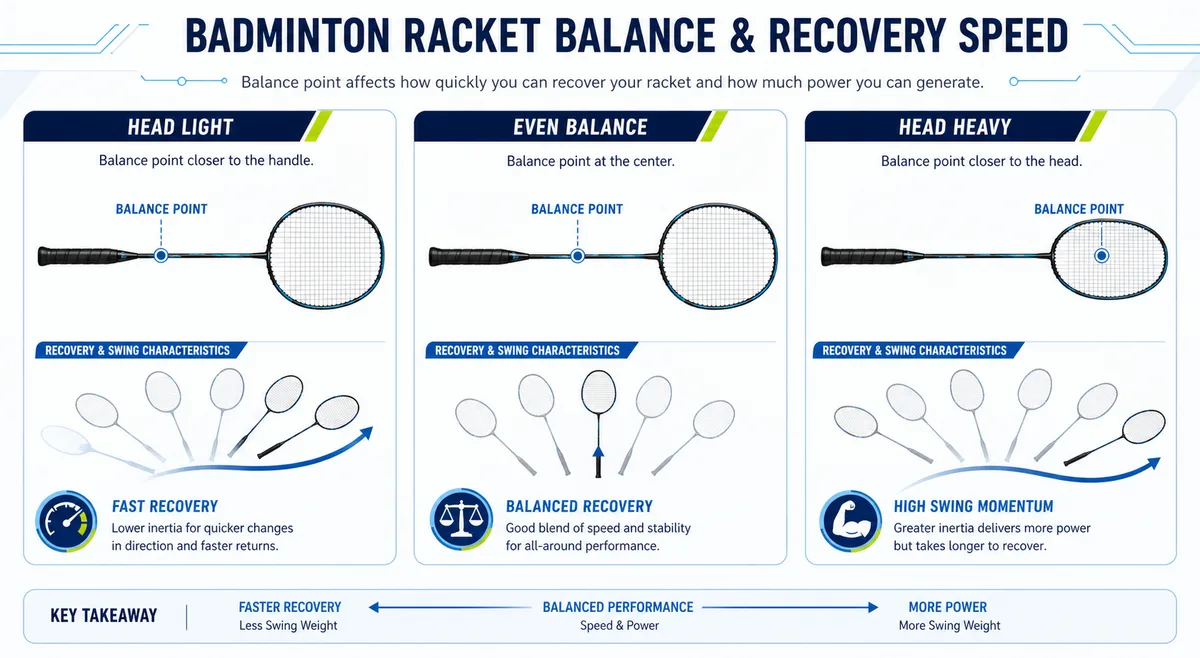
Head heavy, even balance or head light?
Head-heavy rackets emphasize momentum, even-balance rackets emphasize versatility, and head-light rackets emphasize speed.
Head heavy
Supports deep clears and full smashes, but can tire during fast flat exchanges.
Even balance
Offers the safest starting point for players rotating between attack, defense and net play.
Head light
Speeds up blocks and drives, but may demand more effort from the rear court.
| Balance point | Category | Power | Defense | Best fit |
|---|---|---|---|---|
| Below 285 mm | Head light | Moderate | Fast | Doubles defense |
| 285–295 mm | Even balance | Balanced | Balanced | All-round play |
| Above 295 mm | Head heavy | High momentum | Slower | Singles and attack |
Which balance suits singles and doubles?
Singles usually rewards even or moderately head-heavy balance, while fast doubles often rewards even or head-light balance.
- Singles: stability and momentum help repeated full-court clears.
- Doubles: compact preparation helps drives, blocks and body defense.
- Rear-court doubles: moderate head weight can support repeated attacks.
- Defensive singles: a lighter head can improve recovery and counterattack speed.
| Priority | Singles tendency | Doubles tendency | Why it differs |
|---|---|---|---|
| Power | High | Role-dependent | Singles uses more full-length clears |
| Speed | Moderate | High | Doubles exchanges allow less preparation |
| Defense | Court coverage | Reaction defense | Doubles attacks arrive faster |
| Smash | Weight of shot | Repeated attack | Recovery matters after each smash |
| Drive | Useful | Essential | Flat exchanges dominate many doubles rallies |
| Net play | Reach and stability | Fast interception | Front-court player reacts in a smaller space |
| Reaction | Important | Critical | Two opponents reduce available time |
How to measure balance point at home
You can measure a badminton balance point with a ruler and a narrow straight edge.
- Step 1 — Finish the setup.
Install strings and the grip you normally use.
- Step 2 — Find the balance point.
Move the shaft over a pencil until the racket rests level.
- Step 3 — Measure from the butt.
Record the distance from butt cap to support in millimetres.
- Step 4 — Repeat.
Take three readings and use the middle result.
Measurement quality check
| What you observe | Likely cause | Use the result? | Next action |
|---|---|---|---|
| Three readings within 2 mm | Stable support and setup | Yes | Use the middle reading |
| Readings vary by more than 3 mm | Support is too wide or racket is moving | Not yet | Use a narrower edge and repeat |
| Result changed after regripping | Handle mass changed | Use the new result | Compare only with the finished setup |
| Racket balances at an angle | Shaft is not square to the support | No | Level the shaft before measuring |
| Two rackets match in mm but feel different | Weight distribution or stiffness differs | Yes, with context | Compare total weight and shaft next |
Racket balance myth vs fact
Balance point does not tell you exactly how powerful, heavy or difficult a racket will feel.
- Myth: matching balance points feel identical.Fact: total weight and mass distribution still differ.
- Myth: every head-heavy racket swings slowly.Fact: a light 4U model may recover faster than a heavier 3U racket.
- Myth: head weight creates technique.Fact: balance changes delivery; timing still creates shuttle speed.
- Myth: balance point equals swing weight.Fact: it is one static measurement, not rotational inertia.
Top 5 racket balance mistakes
The biggest mistake is treating balance point as a complete measure of racket performance.
- 1. Confusing balance with total weight.
- 2. Measuring before strings and grip are fitted.
- 3. Assuming every doubles player needs head light.
- 4. Ignoring shaft stiffness and weight class.
- 5. Choosing smash momentum without testing recovery.
Racket balance decision guide
Match the balance to the shots you repeat most often, not the shot you hit once in a shop.
- 1. Choose your court role
- 2. Pick momentum or recovery
- 3. Test full rallies
- If you are a beginner: start with even balance.
- If you mainly play fast doubles: test even or head light.
- If your arm tires late in games: reduce head weight before reducing total weight.
- If you attack from the rear court: test moderate head-heavy balance.
- If defense arrives late: prioritize faster recovery.
- If two rackets share a balance point: compare weight and shaft next.
Last updated
Editorial review
Reviewed by Badminton Calculator Editorial Team
Reviewed for calculation consistency, source accuracy and clear separation between general guidance and manufacturer limits.
Sources and reference library
Manufacturer specifications and official rules take priority over general equipment ranges.
- BWF Statutes and LawsOfficial badminton laws and equipment framework.
- Yonex Product SafetyManufacturer guidance on choosing, inspecting and safely using rackets.
- VICTOR Racket Selection GuidePublic guidance connecting playing ability, shaft and racket choice.
- Li-Ning Official Equipment SiteManufacturer product specifications for checking weight, grip and racket series.