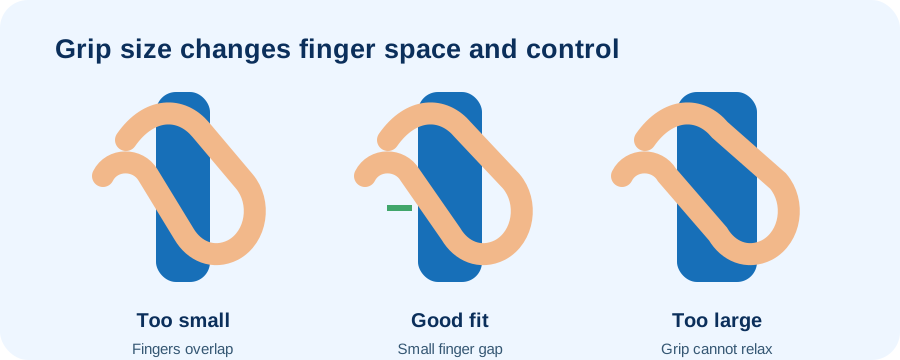
Why badminton grip size matters
A correct badminton grip size lets the hand stay relaxed while the fingers control and accelerate the racket.
Too small
Feels agile but may twist unless you squeeze continuously.
Correct range
Supports relaxed finger power, stable contact and quick grip changes.
Too large
Limits finger movement and can encourage arm-dominant swings.
Badminton grip size quick reference
G4, G5 and G6 are relative handle codes, not universal finished measurements. Within a manufacturer’s badminton range, the higher number generally indicates the slimmer base handle. Always confirm the exact racket specification for your brand, model and market.
| Grip code | Relative size | Typical starting fit | Adjustment notes |
|---|---|---|---|
| G4 | Fuller | Players who already prefer more handle fill | Less room to reduce; use a thin wrap if adding tack |
| G5 | Middle | Practical starting point for many recreational adults | Factory grip or one thin overgrip can fine-tune feel |
| G6 | Slimmer | Smaller hands or a slim-handle preference | Most room to build up gradually with overgrip |
G5 vs G6: which grip size should you choose?
Choose G5 as a starting point when...
- • You want a moderate handle rather than the slimmest base.
- • You are making your first deliberate badminton grip choice.
- • One thin overgrip gives enough room for adjustment.
- • G6 makes you squeeze or feels unstable on normal contact.
Choose G6 as a starting point when...
- • You have smaller hands or clearly prefer a slim handle.
- • Finger movement feels crowded on G5.
- • You want to build the handle up in reversible steps.
- • The finished G6 stays stable without constant squeezing.
What is G5 grip size?
G5 is a common middle option across many badminton racket ranges and a practical starting point for recreational players. It often leaves enough room for a thin overgrip without immediately creating a very full handle. Do not treat G5 as one worldwide circumference: the brand, racket model, sales market, handle shape and factory grip determine the finished feel.
What is G6 grip size?
G6 is generally slimmer than G5 within the same manufacturer’s system. It can provide more room for finger movement and gradual build-up, but slim does not automatically mean faster. If the racket twists during normal contact or you must squeeze throughout a rally, the finished grip may be too small even if the label looked suitable.
Small grip versus large grip
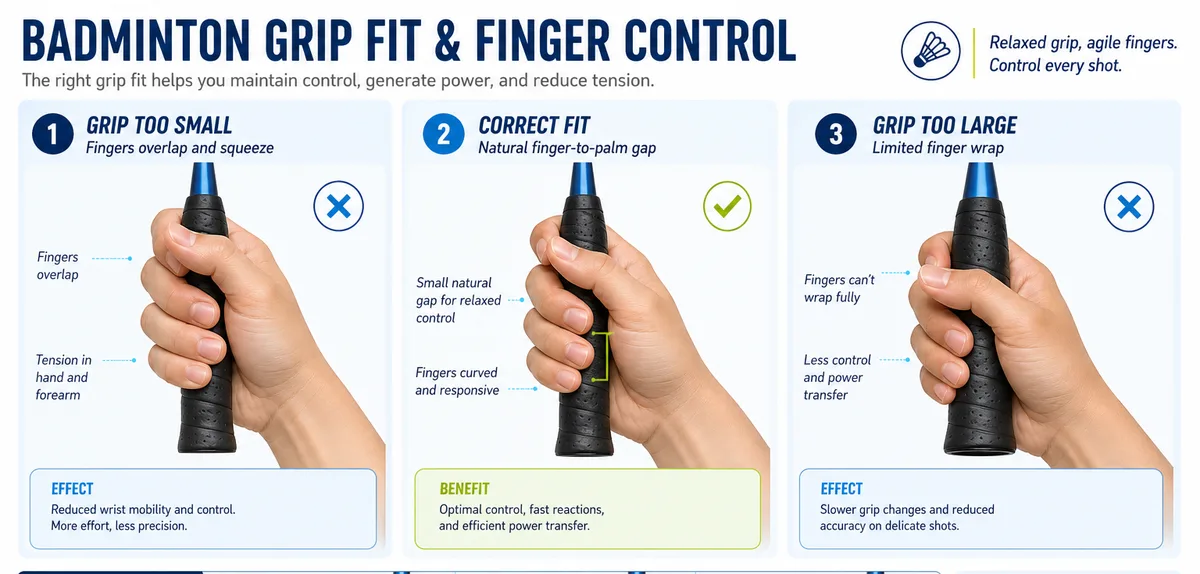
A smaller badminton grip favors finger movement, while a larger grip favors a stable, filled-in hold.
| Fit | Possible advantage | Main disadvantage | Possible strain pattern | First adjustment |
|---|---|---|---|---|
| Too small | Quick finger movement | Twists unless squeezed | Forearm fatigue from over-gripping | Add one thin overgrip |
| Correct range | Relaxed changes and stable contact | No universal feel preference | Lowest avoidable grip-related load | Keep wrap and overlap consistent |
| Too large | Stable full-hand contact | Restricts fingers and bevel changes | Thumb, wrist or forearm tension | Remove a layer or use a smaller base |
How to adjust grip size with overgrip
One overgrip changes the finished grip size. Tape thickness, overlap, wrapping tension and cushioning all affect the result, so two players can wrap the same product and create different handles. Change one layer at a time.
- 1. Add one layer.Use thin tape for fine changes and standard tape for a clearer increase.
- 2. Keep overlap even.Inconsistent overlap creates high spots and misleading fit.
- 3. Retest movement.Check thumb placement, finger power and bevel changes under play speed.
| Tape thickness | Estimated circumference added* | Typical feel change | Best use |
|---|---|---|---|
| 0.4 mm | About 2.5–5 mm | Subtle | Fine adjustment |
| 0.6 mm | About 4–8 mm | Roughly one grip step | Standard overgrip |
| 0.75 mm | About 5–9 mm | Clearly fuller | Small base handle |
| 1.0 mm | About 6–13 mm | Large increase; softer bevels | Major build-up |
*Geometric estimate for one wrap. Stretch, overlap and compression can move the final result outside these ranges; measure the finished handle.
Common grip fitting mistakes
The most common fitting mistake is choosing by the G label without checking the finished handle.
Grip fit checklist
Your grip is probably too large if...
- • Grip changes feel slow or restricted.
- • Your fingers feel crowded around the handle.
- • Racket rotation and bevel changes feel difficult.
Your grip is probably too small if...
- • The racket twists on normal contact.
- • You squeeze constantly to keep it stable.
- • Your fingernails press sharply into your palm.
A single symptom is not a diagnosis. Replace worn tape, relax your hold and test several strokes before changing the base size.
Grip size myth vs fact
Hand length is a useful starting measurement, but it cannot choose a finished grip by itself.
Fact: base grip, tape, overlap and preference change the final circumference.
Fact: excess size can restrict finger power and slow bevel changes.
Fact: a twisting handle often causes extra squeezing instead.
Fact: replace worn tape before changing size or technique.
Top 5 grip fitting mistakes
The biggest grip mistake is adding layers without measuring how the hand behaves during real strokes.
- 1. Assuming G5 means the same finished size for every brand.
- 2. Wrapping with inconsistent overlap.
- 3. Covering the bevels with excessive cushioning.
- 4. Keeping a worn, slippery overgrip.
- 5. Copying a professional player’s handle.
Grip size decision guide
Choose the smallest finished handle that remains stable with a relaxed hand.
- 1. Check the finger gap
- 2. Test twisting and grip changes
- 3. Change one layer
- If your fingers overlap: add a thin overgrip.
- If grip changes feel slow: remove one layer.
- If the racket twists: replace slick tape before increasing size.
- If you mainly use finger power: preserve a small, defined handle.
- If you prefer a stable full grip: build up gradually.
- If you have wrist pain: avoid self-diagnosis and seek qualified advice.
Continue your grip-size decision
Last updated
Editorial review
Reviewed by Badminton Calculator Editorial Team
Reviewed for calculation consistency, source accuracy and clear separation between general guidance and manufacturer limits.
Sources and reference library
Manufacturer specifications and official rules take priority over general equipment ranges.
- BWF Statutes and LawsOfficial badminton laws and equipment framework.
- Yonex Product SafetyManufacturer checks for grip wear, racket damage and safe equipment use.
- VICTOR Racket Selection GuidePublic manufacturer guidance on matching equipment to ability and play style.
- Li-Ning Official Equipment SiteManufacturer product specifications; confirm the regional grip label before buying.